
A Three-Brief Test for Choosing a Scientific Figure Generator
Compare tools with a controlled membrane diagram, a materials cross-section and a multipanel workflow, using specific pass conditions rather than attractive examples.
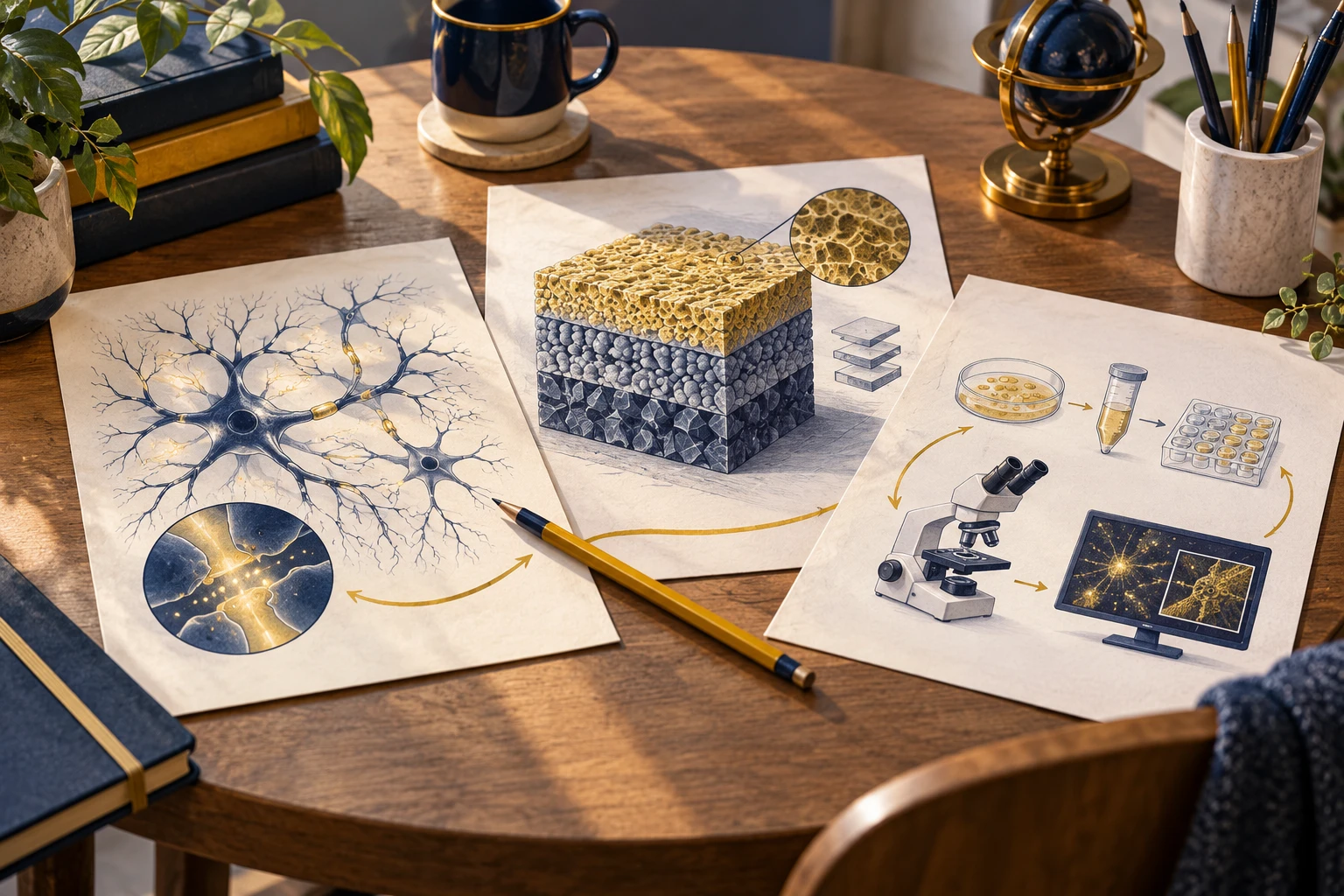
A gallery of excellent examples tells you what a generator can sometimes produce. It does not tell you how many attempts your particular figure will need or whether a coauthor can revise the result. A small controlled trial gives you a more useful answer.
Use the same three briefs, the same number of attempts and the same export destination for each candidate. The following test kit is an original evaluation method, not a ranking of products we have secretly benchmarked.
Brief 1: direction and compartments
Ask for a plasma membrane with one transporter moving a substrate from outside to inside. Require the labels ‘Outside’, ‘Inside’ and ‘Substrate’, exactly one transport arrow, and no nucleus. Provide a simple reference sketch if you own it and can upload it.
Draw an explanatory membrane-transport schematic. Show a horizontal
membrane, Outside above it and Inside below. One transporter spans
the membrane. A single downward arrow shows Substrate entering
through the transporter. Keep all substrate symbols identical.
Do not add organelles, rates, measured values or a second direction.
This tests topology, label accuracy and resistance to adding plausible-looking extra biology. An attractive result with the arrow outside the transporter fails the core brief.
Brief 2: stable geometry during a revision
Use a materials example: a rectangular substrate, a thin coating above it and a magnified inset showing the coating–substrate interface. After generation, request: ‘Change only the coating from blue to green. Preserve the substrate dimensions, inset placement, arrows and labels.’
Compare the before and after images side by side. Record whether unrelated parts moved or changed. A model that creates a beautiful new composition has not necessarily performed the requested local edit.
Brief 3: a multipanel workflow
Ask for three panels showing sample preparation, imaging and analysis. Keep them in that order, use one common legend and leave a blank placeholder where the real plot will later be inserted. The test is whether the tool respects the missing data instead of inventing a convincing chart.
Export the draft, insert a real plot generated from your own test data, and add panel letters in the receiving editor. Time that assembly work. It is part of the figure workflow even when generation itself is fast.
Score observations rather than impressions
Use a score sheet with explicit binary items:
| Criterion | Pass condition | Record separately |
|---|---|---|
| Topology | All required objects connect correctly | Missing or extra objects |
| Exact labels | Every supplied label is correct | Manual text repairs |
| Local edit | Requested change only | Unrequested changes |
| Data boundary | Blank plot area stays blank | Invented quantities |
| Handoff | A coauthor can edit the required objects | Receiving software and version |
Give each candidate up to three initial attempts per brief. Stop at the first accepted draft and record the charged attempts. Do not let one product have unlimited retries while judging another on its first result. Keep failed drafts so the comparison is auditable.
For a hypothetical candidate, your log might read: ‘Membrane: accepted attempt 2; coating: color fixed but inset moved, one manual repair; workflow: accepted attempt 1; label edit possible; total cleanup 24 minutes.’ That says more than ‘very accurate’ or a single star rating.
Match the winner to the work
A team producing classroom illustrations may prioritize clear first drafts. A team preparing mechanism diagrams with frequent terminology changes may prioritize separate editable labels. A team making microscopy panels primarily needs a dependable data-figure workflow, not invented scientific imagery.
You can run the same test in the figure workspace, inspect supported exports in the SVG editor, and assemble panels in the layout workspace. Treat each result as an observed capability of the tested version and account, not a permanent claim about every model.
Choose using the accepted brief count, total revision time and required handoff. If no candidate can satisfy the transport direction reliably, use manual diagram construction for that relationship and reserve AI assistance for less constrained illustration tasks.