
Turn a ChatGPT Figure Draft into a Reviewable Research Document
Check each claim and object in a generated draft rather than equating visual polish with scientific readiness.
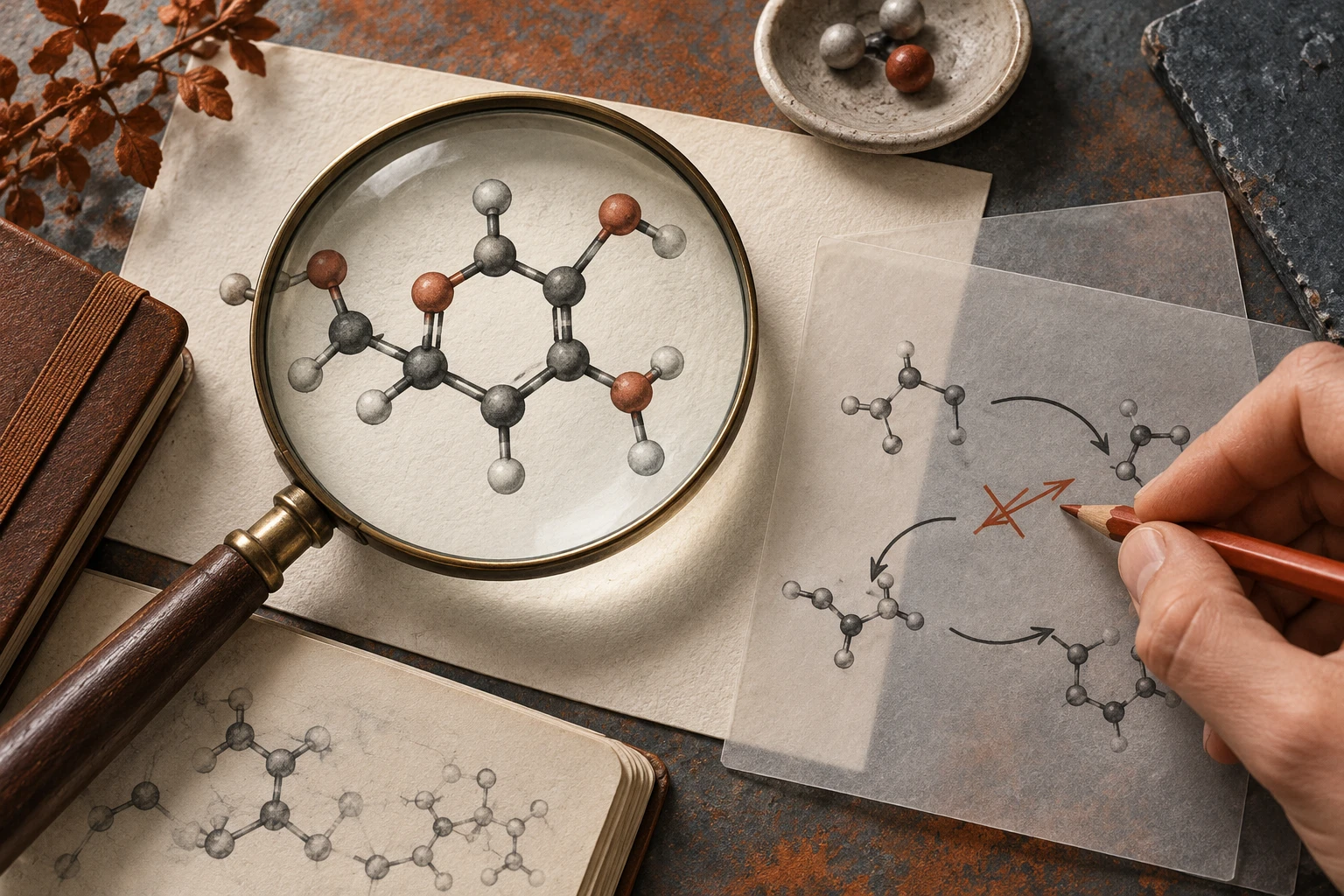
A ChatGPT image can be a useful composition draft and still contain an unsupported scientific claim. Treat the first output as a document to audit. The decisive question is what each mark represents: an experimental observation, a value calculated from data, or an explanatory illustration.
Audit a hypothetical drug-response diagram
Suppose your manuscript reports that treatment A reduced a measured endpoint relative to a vehicle control. A generated draft adds a receptor, a signaling cascade and an arrow labelled “apoptosis.” Those additions are hypotheses unless your experiment established them. A polished mechanism can silently turn a limited observation into a causal claim.
Make a small evidence table before editing the appearance:
| Draft element | Evidence available | Revision |
|---|---|---|
| Treatment A → lower endpoint | Recorded assay result | Retain the measured comparison |
| Treatment A → receptor X | No binding experiment | Remove receptor X |
| Receptor X → apoptosis | No relevant assay | Remove that pathway |
| Decorative cell illustration | Explanatory only | Label it schematic; do not present it as microscopy |
This is an invented teaching example, not a biological finding. Replace every row with your actual methods and results. Ask a colleague to follow each arrow without reading your explanation; this exposes implications the drawing communicates on its own.
Separate policy categories before choosing a tool
As checked on 11 October 2026, Elsevier's current policy distinguishes explanatory diagrams, data visualizations and primary research images. It permits certain explanatory images with review and disclosure; data visualizations must derive from real data through reproducible methods. AI must not fabricate primary research images. General-purpose generative AI is not permitted for graphical abstracts. Read the target journal's own instructions too; changing the product name does not establish acceptance.
Check labels as data, not decoration
Compare labels with the manuscript character by character. “IL-1β,” “IL-1B” and “IL-18” do not communicate the same entity. Verify superscripts, Greek letters, minus signs and units. A later visual edit can preserve a beautiful label while changing its scientific meaning.
Try selecting one word. If the complete figure moves, it is a raster picture. If a letter selects as a path, it is an outline rather than ordinary editable text. In the SVG editor, inspect actual objects before planning a label revision. Vector tracing does not recover a verified biological vocabulary.
Revise the brief instead of hiding the error
For the hypothetical example, a safer drafting instruction is:
Draw an explanatory study-design schematic with two matched groups: Vehicle control and Treatment A. Both feed into a box labelled Measured endpoint. Show no receptor, signaling cascade, mechanism, numerical result or microscopy texture. Use an ordinary arrow only for experimental sequence. Leave the result panel empty for a data-derived chart.
This prompt is a proposed example, not a tested generation. Keep the actual submitted prompt and every returned draft when you run your own experiment. A redraw should remove unsupported relationships, not merely recolor them.
Hand over an audit trail
Deliver the approved figure, source project, actual inputs and a claim-to-source table together. Record the tool/version only when the service provides it; do not guess. Keep a short list of manual corrections and any required disclosure. Use the layout workspace after individual panels pass review. The goal is a figure whose claims can be checked, not a blanket promise that any generated image is publishable.